EU Battery Regulation Cross-vertical
What does the EU Battery Regulation require, and what's actually due by 2027?
The EU Battery Regulation (Regulation (EU) 2023/1542) has applied since 18 February 2024, but its headline obligations phase in by battery type through delegated acts — several of which have slipped. The carbon-footprint declaration for industrial batteries began on 18 February 2026, the digital battery passport becomes mandatory on 18 February 2027 for EV, industrial (over 2 kWh) and light-means-of-transport batteries, and binding supply-chain due diligence was postponed to 18 August 2027.
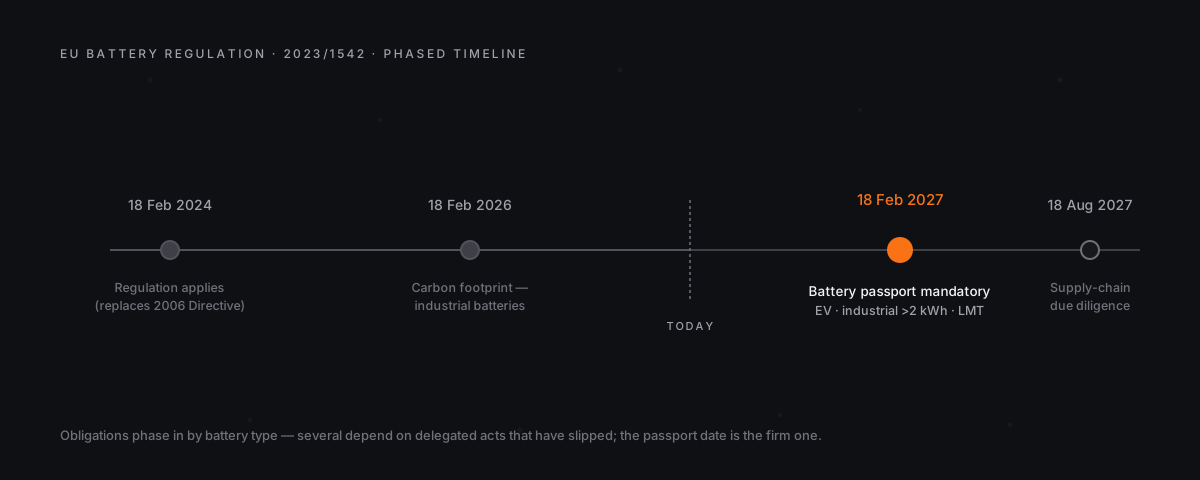
The EU Battery Regulation (Regulation (EU) 2023/1542) has applied since 18 February 2024, but its headline obligations phase in by battery type through delegated and implementing acts — several of which have slipped. The carbon-footprint declaration for rechargeable industrial batteries began on 18 February 2026. The digital battery passport becomes mandatory on 18 February 2027 for EV, industrial (over 2 kWh) and light-means-of-transport batteries. Binding supply-chain due diligence was postponed to 18 August 2027.
What’s already in force?
The regulation replaced the 2006 Batteries Directive and most of its provisions have applied since 18 February 2024 — labelling rules, collection and recycling targets, restrictions on substances, and the framework for the obligations that phase in later. What trips manufacturers up is that the most demanding obligations are not switched on by the regulation itself; they are switched on by separate delegated acts that set the methodology and the format, and those acts run on their own timeline.
That two-layer structure is the single most important thing to understand about this regulation. The dates in the regulation are real, but several depend on a delegated act being published first — and where the act is late, the obligation date moves with it. Planning against the headline date without checking the state of its enabling act is how teams end up either over-building early or scrambling late.
What is the battery passport, and when is it mandatory?
From 18 February 2027, every EV battery, industrial battery above 2 kWh, and light-means-of-transport battery placed on the EU market must carry a digital battery passport, accessible through a QR code. The passport is a structured, machine-readable record of the battery’s identity, composition, performance, and supply-chain history.
The battery passport is the first fully operational member of the same family as the ESPR Digital Product Passport — same QR-code delivery, same typed-data philosophy, exposed at a public endpoint rather than printed on a label. It is the first regime that forces a complete, populated, publicly accessible digital passport rather than a registry entry, which makes it the proving ground for the data infrastructure that broader product passports will later rely on.
The data the passport has to carry is not trivial to assemble. It includes the carbon footprint expressed in kg CO₂e per kWh, the percentages of recycled cobalt, lithium, nickel, and lead, state-of-health and performance parameters, and the supply-chain due-diligence declarations. Most of that lives across different systems — manufacturing, procurement, quality — and has to be projected into one coherent record.
Why have the carbon-footprint and due-diligence deadlines slipped?
Because they depend on acts that arrived late. The carbon-footprint declaration for EV batteries was originally expected to apply from early 2025, contingent on a delegated act setting the calculation methodology and an implementing act setting the declaration format. That methodology act remained in draft well past its intended adoption, which pushed the EV carbon-footprint obligation back; confirm the current applicable date for your battery class against the latest act status before relying on it.
The carbon-footprint declaration for rechargeable industrial batteries took effect on 18 February 2026. The binding supply-chain due-diligence obligations — originally tied to an August 2025 date — were postponed by roughly two years, to 18 August 2027. The lesson for planning is consistent: the further an obligation depends on a methodology act, the more its date can move, and the closer it is to a fixed regulation date, the firmer it is.
What data does the passport actually have to contain?
Treat the passport as an integration deliverable, not a document. The fields cluster into four groups, each owned by a different part of the business:
- Identity and general information — manufacturer, battery model, chemistry, and a unique identifier resolvable from the QR code.
- Carbon footprint — total footprint in kg CO₂e per kWh, with the lifecycle-stage breakdown the methodology act prescribes.
- Recycled content and materials — recycled-content percentages for cobalt, lithium, nickel, and lead, and the critical-raw-material composition.
- Performance, durability and due diligence — state-of-health and expected lifetime parameters, plus the supply-chain due-diligence declaration.
None of these is a single-author document. The carbon footprint comes from the engineering and procurement record; the recycled content from suppliers; the due diligence from the supply-chain function. The work is to project all of it into one typed, versioned record exposed at a public URL — the same shape of problem as the broader EU Digital Product Passport.
What should a manufacturer do now?
Four moves, in priority order, for any team placing EV, industrial, or LMT batteries on the EU market.
- Confirm the live date for each obligation against its enabling act — do not plan against the headline date alone. The battery passport date is firm; the carbon-footprint and due-diligence dates depend on acts that have moved. The EU Battery Regulation deadline tracker keeps the current dates in one place.
- Stand up the identifier and endpoint infrastructure now — a unique identifier per battery, a versioned data endpoint, and QR resolution. This is the same foundation the ESPR DPP needs, so the work compounds rather than duplicates.
- Map the passport fields to their data owners — carbon footprint, recycled content, and due diligence each sit with a different function. Assign owners before the data assembly, not during it.
- Wire the battery passport into the wider passport programme — the identifier infrastructure, supply-chain data, and repairability fields overlap with the EU Right to Repair Directive and the ESPR DPP. One data spine feeding several obligations is the practical architecture; separate data sets per obligation is the failure mode.
For scaling manufacturers, the battery passport is not a labelling task — it is the first time a fully populated digital passport has to be assembled from data spread across engineering, procurement, and the supply chain. ForgeComply maps product context to a regime’s required data structure, surfaces the gaps between what the passport demands and what the product record holds, and generates the identifier payloads from a live product context graph. Where a passport programme today is a regulatory lead and a spreadsheet, software can carry meaningful load.
Key takeaways
- Applies since 18 February 2024 — most of Regulation (EU) 2023/1542 is in force, but the demanding obligations phase in by battery type through separate delegated acts.
- Battery passport mandatory 18 February 2027 — for EV, industrial (over 2 kWh), and light-means-of-transport batteries, delivered via QR code.
- Carbon-footprint declaration for industrial batteries began 18 February 2026 — the EV-battery carbon-footprint date moved with its delegated act and should be confirmed against the latest status.
- Supply-chain due diligence postponed to 18 August 2027 — roughly a two-year shift from the original date.
- The passport is an integration problem — carbon footprint, recycled content, performance, and due-diligence data sit in different systems and have to be projected into one machine-readable record.
- The infrastructure compounds — the identifier and endpoint built for the battery passport are the foundation for the broader EU Digital Product Passport.