ESPR Consumer Electronics
When does the EU Digital Product Passport actually apply to consumer electronics, and what does the 19 July 2026 registry launch mean for manufacturers?
The EU Digital Product Passport (DPP) registry becomes operational on 19 July 2026 under the Ecodesign for Sustainable Products Regulation (Regulation (EU) 2024/1781). Registry launch is not the same as a product DPP becoming mandatory: the registry is the EU-wide infrastructure that holds unique identifiers and commodity codes, while DPP obligations attach product family by product family via separate delegated acts. For consumer electronics, the first wave reaches the mobile-phone, tablet and cordless-phone ecodesign rule already in force from 20 June 2025; broader consumer electronics DPP obligations are expected from 2027 onward.
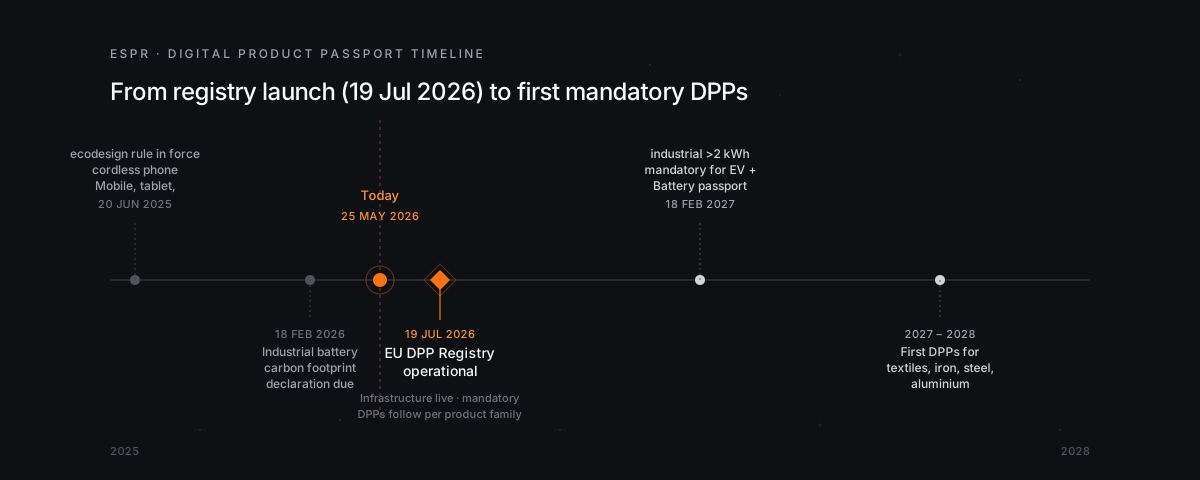
The EU Digital Product Passport (DPP) registry becomes operational on 19 July 2026 under the Ecodesign for Sustainable Products Regulation (ESPR, Regulation (EU) 2024/1781). Registry launch is not the same as a product DPP becoming mandatory. The registry is the EU-wide infrastructure that holds the unique identifiers and commodity codes of regulated products; DPP obligations attach product family by product family via separate delegated acts. For consumer electronics, the first wave reaches the mobile-phone, tablet and cordless-phone ecodesign rule already in force from 20 June 2025. Broader consumer electronics DPP requirements are expected from 2027 onward.
What does the 19 July 2026 registry launch actually do?
The 19 July 2026 date is the load-bearing one because it is the only ESPR-level date that anchors the infrastructure itself, not a specific product family’s obligation. The EU DPP registry — operated centrally by the European Commission — will hold the unique identifiers and commodity codes of every regulated product that subsequently falls under a delegated act [VERIFY: confirm which ESPR article number defines the central DPP registry — secondary coverage attributes it variously to Article 12 and Article 13 of Regulation (EU) 2024/1781].
What goes live on the date is the infrastructure: an EU-level system that can issue, store and verify the identifiers that downstream product-specific delegated acts will mandate. No physical product is required to carry a DPP on 19 July 2026. What is required is that the system to issue and verify a DPP exists, hosted by the Commission, accessible to national market surveillance authorities and resolvable to the public via QR code.
The practical effect is that the regulatory clock for product-specific DPP requirements starts running from a system that actually exists. Before 19 July 2026 the Commission could (and did) draft delegated acts; after 19 July 2026 those acts attach to a working registry that manufacturers can register against. Treat the date as the moment the rails go live, not the moment trains start running.
Which consumer electronics products are in the first DPP wave?
The first wave is narrower than most explainer content suggests. Two product clusters matter for consumer electronics teams reading this in May 2026.
The first cluster is the mobile-phone and tablet ecodesign rule already in force from 20 June 2025 under the ESPR-aligned smartphone and slate-tablet ecodesign delegated act [VERIFY: confirm the exact delegated-act reference number — Commission Regulation (EU) 2023/1670 covers smartphone and slate-tablet ecodesign requirements under the predecessor framework, transitioned into ESPR scope]. The rule covers smartphones, feature phones, cordless phones and slate tablets. Manufacturers placing units on the EU market after 20 June 2025 already have to meet substantive ecodesign requirements — battery endurance of at least 800 charge cycles retaining 80% of original capacity, spare-parts availability within 5 to 10 working days for 7 years after the model is withdrawn from sale, operating-system updates for at least 5 years after the last unit of a model is placed on the market, and non-discriminatory access for professional repairers to the software and firmware needed for component replacement.
The second cluster is the battery passport, mandatory from 18 February 2027 under the EU Battery Regulation (Regulation (EU) 2023/1542) for every electric-vehicle battery, industrial battery and light means of transport battery above 2 kWh placed on the EU market. The battery passport is a sibling of the ESPR DPP — same QR-code delivery, similar data structure — and is the first regulatory deadline that forces a fully-populated digital passport accessible to the public, ahead of the broader ESPR-driven product DPPs.
Beyond these two clusters, broader consumer electronics DPPs are expected to land in 2027 to 2028. The ESPR 2025–2030 working plan prioritises six product families in the first delegated-act wave: textiles and apparel, iron and steel, aluminium, furniture, mattresses and tyres. Consumer electronics beyond mobile phones and tablets — laptops, televisions, audio equipment, wearables — sit inside the ESPR scope but are not in the prioritised first list, and the secondary coverage varies on when their delegated acts land [VERIFY: secondary sources place broader consumer electronics DPP timing variously between 2027 and 2029; confirm against the most recent Commission work-plan amendment].
What data does a consumer electronics DPP have to contain?
The data structure is settling on a stable shape ahead of the registry launch.
The unique identifier of each registered product must comply with ISO/IEC 15459:2015, the standard for electronic capture of unique item identifiers [VERIFY: confirm ISO/IEC 15459:2015 is the operative unique-identifier standard cited in the final consolidated regulation text — most secondary sources reference it but the exact clause reference varies].
The data exchange format is JSON-LD aligned with Schema.org, with GS1 Digital Link as the carrier for the unique identifier and EPCIS 2.0 for supply-chain events. Two European standards — EN 18222 and EN 18223 — define the API structure (RESTful interface, JSON-LD payload) and vocabulary mapping (GS1, ECLASS, ISO, UNSPSC) [VERIFY: confirm EN 18222 and EN 18223 are the operative draft standards adopted ahead of the registry launch — both are still working drafts at the time of writing per CEN/CENELEC publications].
The core data fields, per the Commission’s consolidated guidance for consumer-electronics-class DPPs, include: product model, batch and item identifiers; manufacturer information including EORI number; the party legally responsible for keeping the DPP accurate and current; repairability score; component recyclability; critical raw material content; software support lifetime; and certificate and regulatory-compliance pointers [VERIFY: per-field list varies across secondary sources; confirm exact field list against the consumer-electronics delegated act when published].
The structural point that matters for engineering teams: the DPP is a typed, machine-readable graph keyed off a unique identifier and served from a versioned endpoint. It is not a PDF. Treat it as a public API obligation, not a documentation obligation, and the engineering work falls into a familiar shape — data model, schema, endpoint, versioning, audit trail.
How is the DPP delivered to the consumer?
Article 10 of Regulation (EU) 2024/1781 specifies the QR code as the mandatory delivery mechanism [VERIFY: Article number is cited as Article 10 in some secondary coverage and Article 9 in others; confirm against the consolidated regulation text]. The implementation rule that matters operationally: the QR must be readable without a dedicated application — the native iOS and Android camera must resolve it directly to the DPP data.
That rules out custom-app gating. A manufacturer cannot route the consumer through a brand-specific app, captured-data form, or marketing landing page before serving the DPP payload. The QR resolves to a URL; the URL serves JSON-LD over HTTPS; the consumer’s phone renders it via the OS-level web stack.
Data carriers permitted in addition to QR codes include NFC and RFID. QR is the universal floor — added carrier types are optional and product-specific. RFID is realistic on appliances and high-value electronics where the SKU economics support the chip cost; marginal on mass-market consumer electronics where the per-unit tag cost is hard to absorb.
What does a manufacturer need to do in the next 12 months?
Five practical levers, in priority order for any consumer electronics team likely to be in scope of a delegated act by 2027.
- Map your SKU catalogue against ESPR delegated-act scope — exactly. The mobile-phone and tablet rule is already live; the battery passport hits 18 February 2027; broader consumer electronics DPPs follow 2027–2028. Every SKU needs an owner for the data work, and the owner sequence runs ecodesign first, then battery passport, then broader DPP. The EU Digital Product Passport deadline tracker maps the full registry-and-rollout timeline.
- Build the product-identifier infrastructure now — GS1 Digital Link, ISO/IEC 15459 unique identifiers, JSON-LD payloads served from a versioned endpoint. The 12-to-18-month-to-implement figure that industry analyses keep quoting [VERIFY: specific industry-association or consultancy source for the 12–18 month figure — appears in multiple secondary explainers without single canonical citation] is the supply-chain traceability work, not the front-end QR resolution. Start with the identifier and the endpoint; layer in the supply-chain data once those are working.
- Pull repairability, recyclability and software-support data out of engineering wikis and into the DPP data model — these fields are common across the mobile-phone ecodesign rule, the battery passport and the future consumer electronics DPP. The work compounds: data assembled for one obligation becomes evidence for the next.
- Treat the QR-code endpoint as a production system — uptime, versioning, audit trail. A market surveillance authority pulling a DPP needs a deterministic, machine-readable response. A 404 or a stale payload is the same outcome as no DPP at all.
- Wire the DPP into your repair information portal — the EU Right to Repair Directive (Directive (EU) 2024/1799) applies from 31 July 2026 and requires a free-access repair information portal. The portal and the DPP overlap heavily on data fields (spare-parts SKUs, prices, repair information, support windows). Two parallel deliverables built on one data spine is the practical architecture; two separately maintained data sets is the failure mode that consumes Q3 2026 through Q1 2028.
For scaling consumer electronics businesses, the DPP is not a documentation task — it is an integration task. The product context lives across PLM, ERP, supply-chain systems and engineering wikis; the obligation is to project that context into a typed, machine-readable graph exposed at a public URL. The companies that miss their delegated-act deadline will be the ones where regulatory owned the DPP alone and engineering only found out in Q3 2026. ForgeComply maps product context to regulatory data structures, surfaces inconsistencies between PLM SKUs and DPP-required fields, and generates registry-compliant identifier payloads from a live product context graph. If a DPP programme today is a regulatory lead with a Confluence page, software can carry meaningful load.
Key takeaways
- 19 July 2026 — EU Digital Product Passport registry becomes operational under ESPR (Regulation (EU) 2024/1781). Infrastructure live; mandatory product DPPs follow per delegated act, not on this date.
- Mobile phones, tablets and cordless phones — already inside the ESPR-aligned ecodesign rule from 20 June 2025. First consumer electronics family with substantive material requirements (battery cycles, spare-parts windows, OS update durations, repairer access) in force.
- 18 February 2027 — battery passport mandatory for every EV, industrial and light means of transport battery above 2 kWh. The first DPP with a public-facing deadline, ahead of the broader ESPR rollout.
- 2027–2028 — first broader DPPs for prioritised products in the ESPR 2025–2030 working plan: textiles and apparel, iron and steel, aluminium, furniture, mattresses, tyres. Broader consumer electronics DPP requirements follow.
- Data structure — JSON-LD payload, GS1 Digital Link carrier, ISO/IEC 15459:2015 unique identifier, EN 18222 and EN 18223 for APIs and vocabulary mapping. The DPP is a typed, machine-readable graph — not a PDF, not a marketing landing page.
- Delivery — QR code resolvable by native iOS and Android cameras without a dedicated app. NFC and RFID permitted in addition; QR is the universal floor.
- Operational bottleneck — supply-chain data integration, not the QR endpoint. The 12-to-18-month build figure most explainer content quotes refers to the upstream PLM, ERP and supplier-data work, not to the front-end resolution path.
Sources
- Ecodesign for Sustainable Products Regulation | European Commission
- Implementing the Ecodesign for Sustainable Products Regulation | European Commission
- ESPR 2025–2030 Working Plan | European Commission (July 2025)
- New EU rules for durable, energy-efficient and repairable smartphones and tablets start applying | European Commission (June 2025)
- GS1 Digital Product Passport Provisional Standard | GS1
- Sustainability rules for batteries and waste batteries (Regulation (EU) 2023/1542) | EUR-Lex summary