EU Right to Repair Directive Consumer Electronics
What changes for consumer electronics manufacturers when the EU Right to Repair Directive applies from 31 July 2026?
The EU Right to Repair Directive (Directive (EU) 2024/1799) applies from 31 July 2026. Manufacturers of Annex II products — washing machines, refrigerators, vacuum cleaners, electronic displays, mobile phones, slate tablets, cordless phones, servers, data-storage products, and goods with light-transport batteries — must repair on request at reasonable time and price, provide spare parts and repair information, and accept a 12-month extension of the legal guarantee whenever a consumer chooses repair over replacement. The obligation covers your installed base.
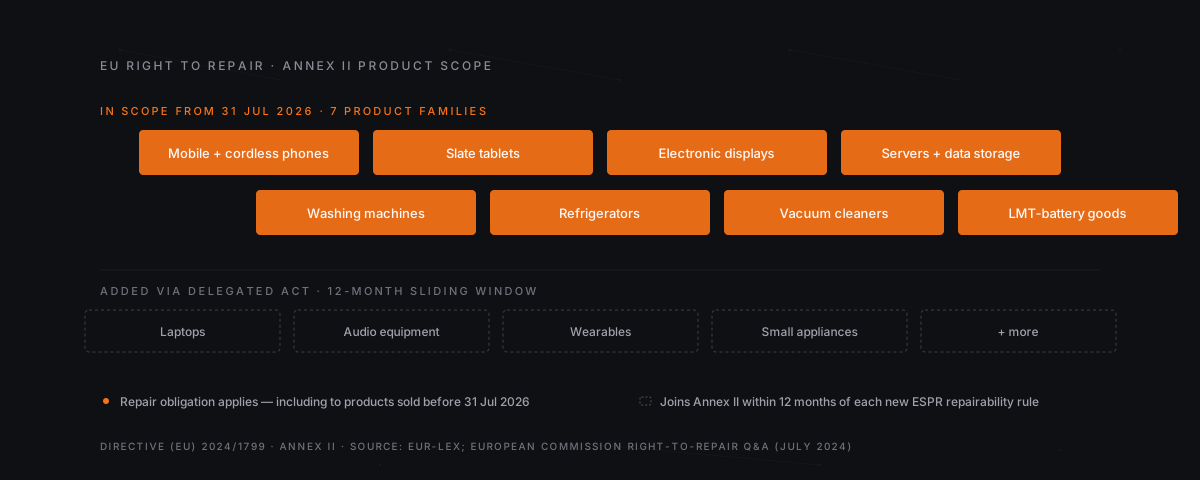
The EU Right to Repair Directive (Directive (EU) 2024/1799) applies from 31 July 2026. Manufacturers of Annex II products must repair on request at reasonable time and reasonable price, provide spare parts and repair information, and accept a 12-month extension of the legal guarantee whenever a consumer chooses repair over replacement. The obligation covers products already on the market, not only those sold after the deadline. Enforcement is national, but the European Online Platform for Repair — expected operational in 2027 — will expose repair data across the EU.
What does the directive actually require?
The Right to Repair Directive sits on top of the EU’s existing repairability framework: the Ecodesign for Sustainable Products Regulation (ESPR), the Sale of Goods Directive, and the product-specific Ecodesign implementing regulations that already mandate spare-parts availability windows for white goods, displays, phones, and tablets. What the directive adds is a repair obligation that runs independently of the consumer guarantee. The core principle is straightforward: if your product is in Annex II and the consumer asks for it to be repaired, you have to repair it — even after the two-year statutory guarantee has expired — for as long as repairability requirements apply to that product family under EU law.
That principle decomposes into five operational obligations the directive places on manufacturers:
- Repair on request — within reasonable time, at reasonable price, using spare parts available at reasonable prices. The obligation runs beyond the statutory guarantee period.
- Spare parts access — for independent repairers as well as authorised networks, without unreasonable hardware or software lock-in. Original, compatible, and 3D-printed spare parts are all permitted; the manufacturer cannot prevent their use.
- Repair information — accessible on a free-access website covering indicative prices for typical repairs and the conditions attached. The technical information independent repairers need to carry out repairs lives here too.
- European Repair Information Form — a voluntary standardised form repairers use to quote a consumer. If a repairer chooses to provide it, the form must be free.
- Twelve-month guarantee extension — when a consumer chooses repair over replacement under their statutory rights, the Sale of Goods Directive is amended to extend the legal guarantee by 12 months from the date of repair. The manufacturer absorbs that exposure.
There is no separate conformity assessment under the directive, no notified body between the manufacturer and the obligation. Enforcement is national, via Member States’ market surveillance authorities operating under the Sale of Goods Directive framework. The European Online Platform for Repair, hosted under the Your Europe portal and expected operational in 2027, will expose repairability data to consumers and competitors alike.
Which products are in scope on day one?
Annex II at the directive’s adoption covers seven product families, all already inside an existing EU repairability regulation:
- Mobile phones, cordless phones, slate tablets — inside the scope of the ESPR mobile phone and tablet ecodesign regulation, in effect from 20 June 2025.
- Servers and data-storage products — inside the existing ESPR server ecodesign framework.
- Electronic displays — TVs and monitors covered by the existing electronic display ecodesign regulation.
- Washing machines and washer-dryers — covered by existing white-goods ecodesign rules.
- Vacuum cleaners — covered by existing vacuum-cleaner ecodesign rules.
- Refrigerators and freezers — covered by existing refrigeration ecodesign rules.
- Goods incorporating light-transport batteries — e-bikes, e-scooters, and similar.
Two structural points matter for product teams reading this:
First, Annex II is not a closed list. The directive requires the European Commission to extend Annex II via delegated act within 12 months of any new EU regulation introducing repairability requirements. ESPR’s 2025–2030 working plan calls out horizontal repairability measures for consumer electronics and small household appliances — laptops, audio equipment, wearables, and other product families currently outside Annex II will be added as those measures come into force. Treat the in-scope list as a 12-month sliding window, not a fixed perimeter.
Second, the repair obligation applies to products sold before 31 July 2026, not only to those sold after [VERIFY: confirm retroactive application against the operative article in the consolidated directive text — most secondary sources state this but the article needs direct citation]. A washing machine sold in 2024 falls under the repair obligation from 31 July 2026 forward. The installed base is in scope on day one, not just the forward catalogue.
What are the operational obligations under the hood?
In practical terms, four work-streams need to be in place before national transposition lands.
- Spare parts inventory and pricing model — reasonable price is not defined as a multiplier or a percentage; the directive’s recitals point to a price that does not in practice deter repair [VERIFY: recital citation for the “reasonable price” interpretation]. The functional bar is that an independent repairer must be able to source a part and quote a repair that a consumer would actually accept. Most Annex II product families already carry minimum spare-parts availability windows under ESPR — seven years for white goods, five years for displays, seven years for phones and tablets [VERIFY: confirm against current ESPR implementing regulation availability tables]. The new directive sharpens the pricing obligation on top of the availability one. High-margin spare parts catalogues should expect public benchmarking via the European Online Platform.
- Repair information portal — a free-access website is now a regulatory deliverable, not a marketing one. Indicative prices for typical repairs, the conditions attached, spare-parts SKUs and prices, and the technical information independent repairers need all live here. The directive does not specify the format — but a market surveillance authority asking a manufacturer to demonstrate compliance will want to see a structured, persistent portal with version history, not a buried FAQ.
- European Repair Information Form readiness — the ERIF is voluntary for repairers but compelling once the European Online Platform launches. A consumer comparing two ERIFs from different repairers is doing a like-for-like price check. If an authorised repair network does not produce ERIFs and independent repairers do, the independent quotes out-compete on transparency alone. Practically, a manufacturer’s repair-management system needs to be able to generate an ERIF on demand from 2027.
- Twelve-month guarantee-extension liability — every repair under the consumer’s statutory guarantee extends that guarantee by 12 months from the repair date. A device repaired in month 23 of its two-year statutory guarantee carries a guarantee window to month 35. Warranty reserves need to be re-sized, and in product families with high failure-then-repair rates — white goods especially — the financial exposure is not trivial.
What’s the practical risk if you’re not ready by 31 July 2026?
National enforcement varies. Germany’s draft transposition routes enforcement through the existing product-safety and consumer-rights framework [VERIFY: confirm current German transposition draft text and competent authority]. France will fold enforcement into DGCCRF’s existing consumer-rights infrastructure [VERIFY: confirm French transposition draft]. The headline risk is not a single large fine; it is the compound effect of a refused repair becoming a consumer complaint, becoming a market surveillance investigation, becoming a published non-compliance, becoming visible on the European Online Platform’s consumer-facing view [VERIFY: the Platform’s exact data model and whether non-compliance flags surface there is not yet final].
For multi-jurisdiction manufacturers, the harder operational risk is that 27 Member States transpose on different timelines and with different national specifics. Germany’s draft already extends some provisions beyond the directive’s floor; other Member States will under-implement and back-fit later. A repair-obligation evidence package needs to satisfy the strictest national interpretation in your sales geography, not the average.
What can you actually do in 60 days?
Five practical levers, in priority order.
- Map your sales catalogue against Annex II — exactly. Every SKU in scope needs an owner for the four work-streams above. SKUs in product families flagged for ESPR addition over 2026–2028 belong on the same map even if they are not in Annex II today; the delegated-act mechanism means they enter scope on a 12-month horizon once their ecodesign rule lands. The EU Right to Repair deadline tracker sets out the transposition and application dates.
- Audit spare-parts pricing — do not assume that reasonable means cost-plus-margin. Benchmark against independent repair quotes available today on iFixit, the Repair Café network, and the consumer-rights NGOs (Right to Repair Europe, BEUC). If an authorised spare part price is three to five times the independent-repair equivalent, that gap is the gap regulators will see when the European Online Platform exposes it.
- Stand up the repair information portal as a structured deliverable, not a marketing page. Version-controlled, accessible, machine-readable where possible. ESPR’s Digital Product Passport (registry operational from 19 July 2026 per the Commission’s 2025–2030 working plan) will eventually be the canonical reference; the repair information portal should align to DPP data structures from the outset to avoid double work in 2027.
- Quantify the 12-month guarantee-extension exposure — pull warranty data for the past five years; identify the products and failure modes most likely to drive a “repair-then-extended-guarantee” pattern; size the reserve adjustment. Finance will appreciate the heads-up before Q3 2026 close.
- Hold one cross-functional working session per affected product family — engineering, regulatory, customer service, finance. The directive cuts across functions in a way that no single function can own. The companies that miss the deadline will be the ones where regulatory owned it alone and engineering only found out in Q2 2026.
For most scaling consumer-electronics businesses, the bottleneck is not the legal text. It is the evidence-assembly work that runs upstream of the deadline — spare-parts catalogues normalised against ESPR availability windows, repair-procedure documentation pulled from engineering wikis into a consumer-facing portal, ERIF templates wired into the repair-management system, warranty reserves re-sized against five years of failure data. ForgeComply’s evidence-assembly modules are built for exactly this kind of work: mapping product context to regulatory obligations, surfacing inconsistencies between spare-parts catalogues and ESPR availability tables, and generating repair-information artefacts from a live product context graph rather than hand-written copy. If a repair-obligation programme is currently a regulatory lead and a spreadsheet, software can carry meaningful load.
Key takeaways
- 31 July 2026 — Member States’ deadline to transpose Directive (EU) 2024/1799 into national law. Repair obligations attach from that date.
- Annex II products in scope — washing machines, refrigerators, vacuum cleaners, electronic displays, mobile phones, slate tablets, cordless phones, servers, data-storage products, goods with light-transport batteries. List expands via delegated act within 12 months of any new EU repairability regulation.
- Five operational obligations — repair on request at reasonable time and price, spare parts access at reasonable prices, free-access repair information portal, voluntary European Repair Information Form, 12-month extension of the legal guarantee when repair is chosen over replacement.
- Installed base is in scope — the repair obligation covers products sold before 31 July 2026, not only after. Day-one exposure is the historical catalogue.
- European Online Platform for Repair — pan-EU consumer-facing platform expected operational in 2027 under the Your Europe portal, with national sections linked via a common interface. Consumers will use it to compare repairers, refurbished-goods sellers, and defective-goods purchasers.
- Operational bottleneck — not the legal text; the evidence-assembly work that normalises spare-parts catalogues, repair-procedure documentation, ERIF templates, and warranty reserves against the obligation. One cross-functional working session per product family is the practical lever.
Sources
- Directive on repair of goods | European Commission
- Common rules promoting the repair of goods (Directive (EU) 2024/1799) | EUR-Lex summary
- Right to Repair Q&A | European Commission (July 2024)
- Right to repair products | Council of the EU
- Implementing the Ecodesign for Sustainable Products Regulation | European Commission
- Right to Repair: Making repair easier and more appealing to consumers | European Parliament