PMTA Vape
What gets a PMTA refused at FDA's acceptance and filing review?
Most PMTAs that fail early never reach a scientist. FDA runs two completeness gates before substantive review: an acceptance review for format and administrative completeness, and a filing review for whether the application holds enough information to evaluate. A missing environmental assessment, absent labeling, no literature search, or — from 2 January 2026 — the wrong submission forms can trigger a refuse-to-accept or refuse-to-file letter before the science is read.
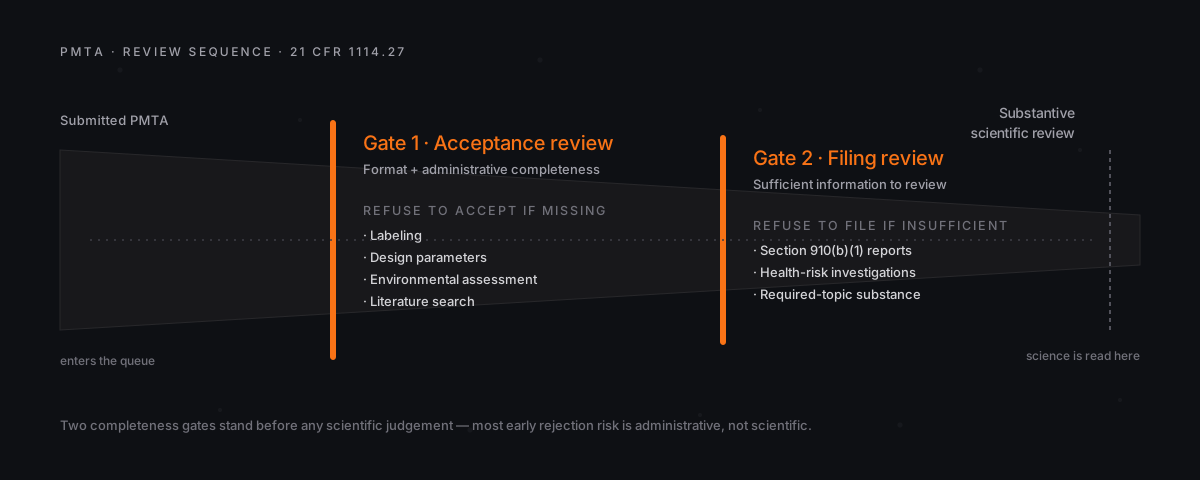
Most PMTAs that fail early never reach a scientist. Before FDA evaluates whether your product is appropriate for the protection of public health, it runs two completeness gates: an acceptance review for format and administrative completeness, and a filing review for whether the application holds enough information to support a substantive evaluation. A missing environmental assessment, absent labeling, no literature search, or — from 2 January 2026 — the wrong submission forms can trigger a refuse-to-accept or refuse-to-file letter before the science is read.
What happens before FDA reviews the science?
A premarket tobacco product application does not go straight to scientific review. The review procedure in 21 CFR 1114.27 sets out distinct phases, and the first two are administrative checkpoints that decide whether the application is even allowed to proceed.
The first is the acceptance review. After you submit, FDA performs an initial review to decide whether the application may be accepted for further review at all. If it is accepted, FDA issues an acknowledgement letter that specifies the application’s submission tracking number (STN). If it is not, you receive a refuse-to-accept letter and the application stops.
The second is the filing review. Once an application is accepted, FDA makes a threshold determination of whether it contains enough information to permit a substantive review. If it does not, FDA issues a refuse-to-file letter. Only after an application is filed does the substantive scientific review begin. The two gates exist so that reviewers spend their time on applications that are actually reviewable — which means a large amount of the rejection risk sits in administrative completeness, not science.
What gets a PMTA refused at the acceptance gate?
The acceptance review is about format and administrative completeness, not the strength of your evidence. FDA may refuse to accept an application that does not comply with the applicable format requirements, that is not administratively complete because it does not appear to contain the required information, or that does not pertain to a tobacco product subject to chapter IX of the Federal Food, Drug, and Cosmetic Act.
In practice, the items that draw a refuse-to-accept decision are the ones a reviewer can check for presence without reading the science. FDA has described submissions it would refuse to accept as those lacking core components such as labeling, design parameter information, an environmental assessment, or a literature search.
- Labeling — the product labeling has to be present and consistent with the rest of the application.
- Design parameters — the physical and operating specifications of the product, such as e-liquid composition, device characteristics, and emissions, have to be supplied.
- Environmental assessment — covered in its own section below, this is one of the most common single-document gaps.
- Literature search — a documented search of the published literature relevant to the product’s health risks.
The deeper point for anyone running submissions is that none of these are scientific judgements. They are completeness checks. An application can hold genuinely strong toxicology and behavioural data and still be turned away at the door because one required document is missing or one section is internally inconsistent. The same completeness discipline governs an FDA medical-device submission — see the documentation FDA Section 524B requires in a premarket submission.
What gets a PMTA refused at the filing gate?
The filing review asks a different question: is there enough substance here to review? FDA may refuse to file a PMTA if it does not contain sufficient information required by section 910(b)(1) of the Federal Food, Drug, and Cosmetic Act, and the implementing requirements in 21 CFR 1114.7, 1114.15, or 1114.17 as applicable, to permit a substantive review.
Section 910(b)(1) is the load-bearing clause. It requires full reports of all information, published or known to the applicant — or that should reasonably be known — concerning investigations made to show the health risks of the tobacco product and whether it presents less risk than other tobacco products. A filing review does not weigh whether that evidence is persuasive; it checks whether the categories of required information are present in a reviewable form. An application that is silent on a required topic, or that gestures at it without substantive content, is a refuse-to-file candidate.
This is the gate that separates a thin application from a complete one. Acceptance asks whether the documents are there; filing asks whether the documents say enough to be evaluated. Both happen before a single scientific conclusion is judged.
Why does the environmental assessment cause so many early rejections?
The environmental assessment deserves singling out because it sits across both gates and is a recurring early-failure point. FDA’s regulations implementing the National Environmental Policy Act require an environmental assessment, or a claim of categorical exclusion, for any application requesting agency action. There are currently no categorical exclusions for tobacco products, so an environmental assessment prepared under 21 CFR Part 25 has to be submitted as part of every PMTA.
The consequence is blunt: the absence of an environmental assessment, or an inadequate one, is a leading cause of refuse-to-accept and refuse-to-file letters. It is a document that has nothing to do with whether the product is appropriate for the protection of public health, yet it can stop the application before that question is ever asked. That asymmetry — a procedural requirement gating a scientific review — is exactly the kind of failure mode that is avoidable with disciplined evidence assembly rather than expensive after-the-fact remediation.
What changes with the new PMTA forms on 2 January 2026?
There is a near-term administrative trap worth flagging on its own. FDA has updated the four forms required for new tobacco product applications under the PMTA and Substantial Equivalence pathways — Forms FDA 4057, 4057a, 3965, and 3965a — and moved them onto web-based forms in the CTP Portal Next Generation, with updated PDF versions also available.
From 2 January 2026, applicants must use the latest version of these forms. If an applicant does not use the latest version, or does not complete the forms properly, FDA generally intends to refuse to accept the application. This is a pure administrative gate: an otherwise complete submission filed on a superseded form is a refuse-to-accept risk. For any team with a submission in flight across the new-year boundary, confirming the form version is the cheapest rejection you will ever avoid. The lesson mirrors the broader timeline reality of FDA submissions covered in how long a 510(k) actually takes and what slows it down.
How do you keep a PMTA out of the refuse-to-accept pile?
The pattern across both gates is the same: the early rejections are completeness and consistency failures, not scientific ones. That makes them the most preventable and the most infuriating to lose on. Four habits keep an application moving past the gates.
- Build a required-documents checklist from the regulation, not from memory — labeling, design parameters, environmental assessment, literature search, and the section 910(b)(1) health-risk information each have to be present and reviewable before the science is read.
- Treat the environmental assessment as a first-class deliverable — not an annex assembled the week before submission. Its absence or inadequacy alone can trigger a refuse-to-accept or refuse-to-file decision.
- Check for cross-section consistency — administrative completeness includes whether the application appears to contain what it claims; a design parameter cited in one section and missing from another reads as incomplete.
- Confirm the form version before you submit — from 2 January 2026 the wrong form version is its own refuse-to-accept ground, independent of content quality.
This is the kind of work where a live model of the product’s evidence earns its place. ForgeComply maps a regime’s required-evidence structure to your specific product and flags the gaps — the missing environmental assessment, the design parameter that appears in one section and not another, the literature search that was never logged — before a submission goes out rather than after a refuse-to-accept letter comes back. The acceptance and filing gates reward exactly that discipline, because they are checking for presence and completeness rather than judging the science. The same pathway-and-completeness logic runs through every regulated-hardware regime, including how the EU Cyber Resilience Act assigns a conformity assessment route.
Key takeaways
- Two gates before science —
21 CFR 1114.27runs an acceptance review (format and administrative completeness) and a filing review (sufficient information under section 910(b)(1)) before any substantive scientific review begins. - Acceptance is a presence check — FDA may refuse to accept an application lacking labeling, design parameters, an environmental assessment, or a literature search, regardless of how strong the underlying data is.
- Filing is a sufficiency check — a refuse-to-file decision turns on whether the application holds enough required information to permit substantive review, not on whether that information is persuasive.
- The environmental assessment is a recurring trap — with no categorical exclusions for tobacco products, its absence or inadequacy alone can cause a refuse-to-accept or refuse-to-file decision.
- New forms from 2 January 2026 — applicants must use the latest form versions; the wrong version is an independent refuse-to-accept ground.
- Early rejections are preventable — completeness and consistency failures, not scientific ones, drive most early refusals, which is where disciplined evidence assembly carries the load.
Sources
- 21 CFR 1114.27 — Review procedure | eCFR
- 21 CFR Part 1114 — Premarket Tobacco Product Applications | eCFR
- Preparing and Submitting a Premarket Tobacco Product Application | FDA
- FDA Tobacco Product Application Tips | FDA
- Submit Documents via CTP Portal Next Generation | FDA
- 21 CFR Part 25 — Environmental Impact Considerations | eCFR