510(k) Medtech
How long does a 510(k) submission actually take in 2026, and what's slowing it down?
The FDA's MDUFA V goal is a 90-day decision on 510(k) submissions, met 95% of the time on FDA's clock. The real-world average is closer to 164 FDA days, and the calendar gap to clearance often runs 6–9 months. The single biggest delay is the Additional Information request, which pauses the clock and gives sponsors 180 days to respond. In 2026, QMSR enforcement, rising volumes, and AI/ML device complexity are widening the gap.
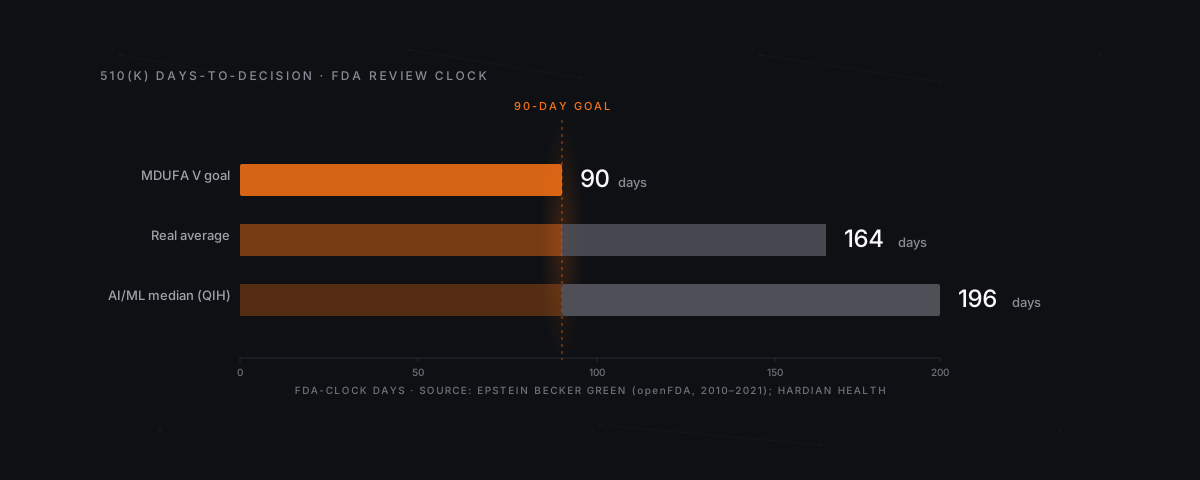
The FDA’s MDUFA V goal is a 90-day final decision on 510(k) submissions, met 95% of the time on FDA’s review clock. The real-world average is closer to 164 FDA days, and the calendar gap from submission to clearance often runs 6–9 months. The single biggest delay is the Additional Information request, which pauses the FDA clock and hands the sponsor a 180-day response window. In 2026, QMSR enforcement, rising submission volumes, and AI/ML device complexity are widening that gap.
What does the FDA officially commit to?
Under the Medical Device User Fee Amendments V (MDUFA V), which covers fiscal years 2023 through 2027, the FDA commits to a tiered set of review milestones for Traditional 510(k) submissions. The headline numbers are well-published, but the conditional structure matters more than the headlines.
The FDA goal is to issue a MDUFA decision on 95% of Traditional 510(k) submissions within 90 FDA days. A Substantive Interaction — the first detailed reviewer touchpoint after acceptance — happens within 60 calendar days of receipt for 95% of submissions. An initial acceptance-review decision lands within 15 calendar days of receipt; if FDA does not complete acceptance review in that window, the submission proceeds to substantive review by default. Special 510(k) submissions, which cover design changes by the same manufacturer to a previously cleared device, are reviewed against a 30-day target instead of 90.
Critically, those are FDA days — calendar days where the review clock is running. The clock stops when FDA issues an Additional Information request, an electronic Hold Letter, or any other notice that puts the ball in the sponsor’s court. It restarts when the sponsor responds. The MDUFA V goal explicitly excludes sponsor time, which is why the headline numbers and the actual calendar-time experience diverge so sharply.
MDUFA V also introduces a Shared Outcome Total Time to Decision commitment that includes both FDA and industry time. The FY2025 target is 112 calendar days, with a conditional improvement to 108 days in FY2026 and FY2027 if FDA hits earlier performance triggers. The Shared Outcome metric is a better predictor of what a sponsor’s calendar will look like — but FDA commits to it as a directional goal, not the 95% statistical bar that applies to the FDA-clock target.
If FDA exceeds 100 FDA days without a decision (10 days past goal), it issues a Missed MDUFA Communication — written feedback the sponsor can discuss in a meeting or teleconference. This is the closest thing to an escalation lever in the standard process.
How long does a 510(k) actually take in 2026?
The empirical answer is well-documented. An analysis of approximately 25,000 510(k) submissions from January 2010 through September 2021 (Epstein Becker Green, using openFDA data) found the average FDA-clock time was 163.5 days from submission to decision. More recent industry analyses (Hardian Health, Emergo by UL) report averages in the 140–175-day range, with most submissions clustering between 140 and 200 total days before a substantial-equivalence decision lands.
For the QIH product code specifically — radiological computer-assisted detection and diagnosis, which captures a large share of recent AI/ML clearances — the median time to decision was 196 days and the average was 201 days (Hardian Health). That’s roughly three months over the 90-day target. AI/ML submissions also see Additional Information requests at higher rates, driven by novel algorithmic considerations the reviewer cannot map directly to predicate experience.
Calendar-time from concept to clearance tells a longer story. One industry analysis put the median time from concept to FDA decision at 31 months, reflecting that submission preparation — device testing, verification and validation, clinical-evidence assembly, predicate selection, drafting — typically eats 4–5 months before the package reaches FDA. Many sponsors underestimate that front-end weight and end up restarting tests mid-review.
A practical planning heuristic: assume a 6-month calendar window from submission to clearance for a clean, well-prepared Traditional 510(k) with no clinical data requirement. Assume 9–12 months if your device needs clinical evidence or sits in a complex product code. Special 510(k)s with no significant design changes can come in under 90 calendar days if the package is well-structured.
Why is the median running closer to 164 days than 90?
One delay mechanism explains most of the gap: the Additional Information request. After the acceptance review and substantive interaction, the FDA reviewer can issue an AI request — either interactively, mid-review, or as a formal Hold Letter, typically by review day 60. The Hold Letter pauses the review clock entirely. The sponsor has 180 calendar days to respond. If the sponsor does not respond within 180 days, the submission is considered withdrawn and deleted from the queue.
The AI request is not an exception case. It’s the modal outcome. Most first-time 510(k) submissions receive at least one AI request before clearance, and many receive two or three rounds of back-and-forth.
Industry analyses consistently flag the same operational triggers:
- Mismatched indications for use — the indications statement on the cover sheet does not match the 510(k) Summary, the Instructions for Use, and the Substantial Equivalence Discussion. FDA cannot reconcile what the device claims, so it asks the sponsor to do so.
- Missing “not applicable” statements — every required section that the sponsor leaves blank reads as missing, not as inapplicable. FDA expects an explicit one-line justification for every section that does not apply.
- Clinical-evidence gaps — when technological differences from the predicate are sufficient that bench data alone cannot demonstrate substantial equivalence, FDA wants clinical data. If the sponsor anticipated a non-clinical submission, the gap surfaces only after the substantive interaction.
- Disorganised packages — the average 510(k) is now over 1,000 pages and reviewers need to navigate it efficiently. Poor cross-referencing, missing eSTAR fields, and orphaned attachments slow review and trigger requests.
A second delay vector is the Hold Letter for administrative reasons. If the eSTAR submission is malformed, the user fee is unpaid, or the eCopy is non-conformant, FDA issues a Hold Letter usually within 7 days of receipt. The sponsor has 180 calendar days to resolve. eSTAR has been mandatory for nearly all 510(k) submissions since 1 October 2023 (narrow exemptions exist); sponsors still occasionally underestimate its structural rigidity.
What’s changing in 2026 that is making this worse?
Three pressure points are converging.
First, the Quality Management System Regulation (QMSR) entered enforcement on 2 February 2026, restructuring 21 CFR Part 820 to align substantially with ISO 13485:2016. Sponsors whose quality systems were tuned for the old framework are reworking documentation hierarchies, design history files, and design-controls evidence to match the QMSR/13485 vocabulary. Submissions filed during this transition carry novel documentation patterns reviewers also need to absorb, and inconsistencies trigger Additional Information requests.
Second, FY2025 CDRH premarket submission volume across all types reached approximately 21,700, with roughly 3,238 510(k) clearances. CDRH also lost an estimated 230–250 staff across two HHS layoff rounds in early 2025. More submissions, fewer reviewers, longer queues. The MDUFA V bar still applies, but the system is operating closer to capacity than it was at the start of the user-fee cycle.
Third, the average 510(k) submission length has more than doubled compared to ten years ago and now routinely exceeds 1,000 pages — a figure CDRH itself has cited in justifying recent program changes. Every additional page is more review time, more cross-references to track, more places where indications-for-use language can drift between sections. Submissions get heavier because devices get more complex — software, connectivity, AI/ML components, more demanding cybersecurity expectations — and because FDA’s documentation expectations have ratcheted up across all classes.
The three compound. A bigger submission, prepared under a transitioning quality framework, reviewed by a stretched team, surfaces more inconsistencies — and each one means another AI cycle.
What can you actually do to shorten your timeline?
There are five practical levers, in priority order.
- Match indications for use across every section, exactly. Before submission, run a string-level diff across the cover sheet, the Summary, the IFU, and the Substantial Equivalence Discussion. Reviewers cannot reconcile differences for you; they will ask you to do it.
- Write explicit “not applicable” justifications for every section you leave empty. A one-line sentence — “Section X.Y does not apply because the device contains no software components” — costs less than an AI cycle.
- Resolve the clinical-evidence question before you submit, not during review. Use a Pre-Submission meeting (Q-Submission) to align with FDA on what evidence is required. The Q-Sub adds calendar weeks up front but typically removes months of mid-review delay.
- Build the submission against the eSTAR field map, not against your internal documentation structure. eSTAR is unforgiving about field types, attachments, and naming. The closer your internal structure matches what eSTAR expects, the less re-formatting work — and the lower the risk of a Hold Letter on day 7.
- Treat the substantive interaction as a deadline, not a touchpoint. The 60-day substantive interaction is when reviewers surface concerns. Pre-empting those concerns in the package — through annotated risk traceability, predicate comparison tables, and explicit risk-control trace from hazards through verification evidence — means substantive interactions become confirmations rather than course-corrections.
For most scaling Medtech companies, the bottleneck is not the FDA review clock. It is the evidence-assembly work that runs upstream of submission, and the cross-reference reconciliation that has to be done by the regulatory lead and the responsible engineer manually. ForgeComply’s evidence-assembly modules are built for this — mapping requirements to verification evidence to standards clauses, generating Substantial Equivalence Discussion drafts from a live product context graph, and surfacing indications-for-use mismatches across sections before submission rather than after FDA asks. If your sustaining team is one Additional Information cycle away from a 6-month delay, software can carry meaningful load.
Key takeaways
- 90 FDA days — MDUFA V final-decision goal for Traditional 510(k) submissions, met 95% of the time on FDA’s clock. Special 510(k)s target 30 days.
- 164 FDA days — empirical average from a ~25,000-submission analysis covering 2010–2021 (163.5 days, Epstein Becker Green using openFDA data). Calendar gap to clearance typically 6–9 months.
- AI/ML devices run longer — median 196 FDA days for QIH-coded submissions (radiological CADx), roughly three months over goal.
- The Additional Information request — the dominant delay mechanism. Pauses the FDA clock and gives the sponsor 180 days to respond. Most first-time submissions get at least one round.
- Top operational triggers — indications-for-use mismatches across sections, missing “not applicable” justifications, clinical-evidence gaps surfaced mid-review, disorganised eSTAR packages.
- 2026 pressure points — QMSR enforcement from 2 February 2026, FY25 CDRH premarket volume around 21,700 across all submission types, average 510(k) now over 1,000 pages, CDRH staff reductions in early 2025. The system is operating closer to capacity than it was at the start of MDUFA V.
Sources
- 510(k) Submission Process | FDA
- MDUFA Performance Goals and Procedures, Fiscal Years 2023 through 2027 | FDA
- 510(k) Submission Programs | FDA
- eSTAR Program | FDA
- QMSR — Quality Management System Regulation FAQ | FDA
- CDRH Statement: Continuing to Strengthen the 510(k) Program | FDA
- Unpacking Averages: FDA Review Time for 510(k)s | Epstein Becker Green
- How long does an FDA 510(k) actually take? | Hardian Health