TPD Vape
What does the EU TPD require to notify an e-cigarette before it can go on sale?
Before an e-cigarette or refill container can be sold in the EU, its manufacturer or importer must notify each member state's competent authority through the EU Common Entry Gate (EU-CEG), six months before placing it on the market. The notification is a structured dossier — ingredients, emissions, toxicological data, nicotine dosing, device design, and the production process. It is not an approval. The six-month standstill, data completeness, and product limits are the real gates.
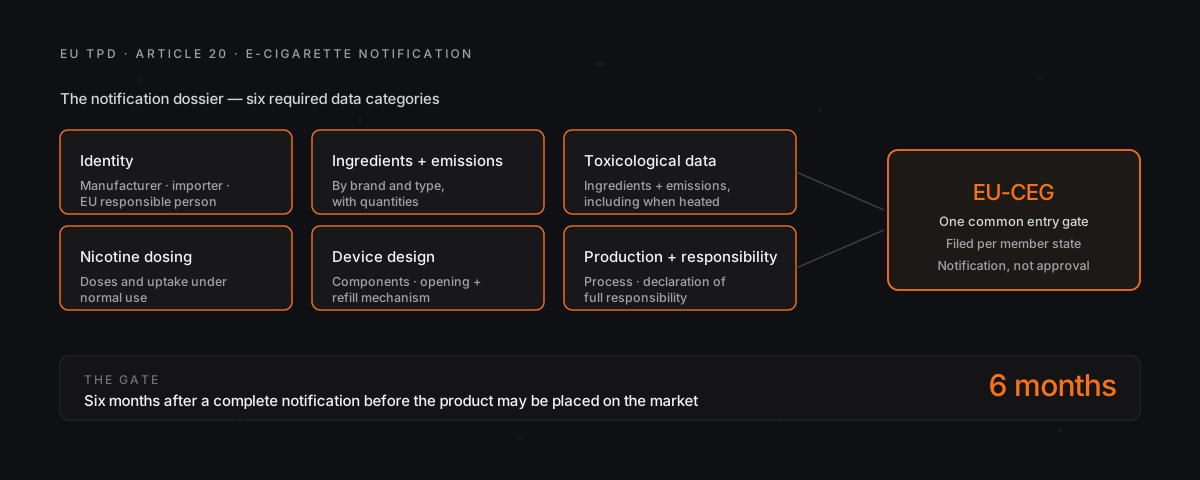
Before an e-cigarette or refill container can be sold in the EU, its manufacturer or importer has to notify each member state’s competent authority through the EU Common Entry Gate (EU-CEG) — six months before placing it on the market. The notification is a structured dossier: ingredients, emissions, toxicological data, nicotine dosing, device design, and the production process. It is not an approval. The six-month standstill, the data completeness, and the product limits are the real gates.
What does “notify” mean under the TPD — and why isn’t it approval?
The EU Tobacco Products Directive — Directive 2014/40/EU — regulates electronic cigarettes and refill containers in Article 20 [[EU-TPD-2014-40-Article-20]]. Unlike a US premarket tobacco product application, the TPD does not ask a regulator to authorise your product. It runs a notification regime: you tell the competent authorities what the product is and what is in it, and you may sell once the standstill period has passed, provided the product complies.
That distinction sets the operating model. There is no marketing order, no scientific verdict, and no day when an authority writes back to say “approved.” The obligation is on the manufacturer or importer to file a complete, accurate notification and keep the product within the directive’s limits; the absence of an objection is not an endorsement. So completeness and accuracy, not a regulator’s verdict, decide whether you are on the market on time.
What has to be in an e-cigarette notification?
Article 20 sets out the information a notification must contain for each product, submitted by brand name and type [[EU-TPD-2014-40-Article-20]]. The required categories are a structured dossier, not a free-form filing.
- Identity — the name and contact details of the manufacturer, the responsible legal or natural person within the Union, and the importer where applicable.
- Ingredients and emissions — a list of all ingredients contained in, and emissions resulting from the use of, the product, by brand name and type, including the quantities of each.
- Toxicological data — data on the product’s ingredients and emissions, including when heated, and their effects on health, including any addictive effect. [VERIFY: confirm the exact toxicological-data wording in Article 20(2) against the EUR-Lex consolidated text]
- Nicotine dosing — information on the nicotine doses and uptake when the product is consumed under normal or reasonably foreseeable conditions.
- Device design — a description of the components of the product, including, where applicable, the opening and refill mechanism of the e-cigarette or refill container.
- Production and responsibility — a description of the production process and a declaration that the manufacturer or importer bears full responsibility for the quality and safety of the product when placed on the market and used under normal conditions. [VERIFY: confirm the production-process and full-responsibility declaration sit in Article 20(2)]
The format is not left to the filer. Commission Implementing Decision (EU) 2015/2183 establishes the common electronic format for notifying e-cigarettes and refill containers, submitted through the EU-CEG — the categories above are the substance, the implementing decision is the schema. The same completeness logic governs premarket evidence in other regulated-hardware regimes — see the documentation FDA Section 524B requires in a premarket submission, where a missing machine-readable artefact is the recurring friction point rather than the strength of the underlying work.
What product limits does a notification have to meet?
A notification is also an implicit claim that the product sits inside the directive’s hard limits. Article 20(3) constrains the product itself, and a notification for a product outside these limits is one for a product that cannot lawfully be sold [[EU-TPD-2014-40-Article-20]].
- Nicotine strength — nicotine-containing liquid may not exceed a concentration of 20 mg/ml.
- Refill container volume — nicotine-containing liquid may be placed on the market only in dedicated refill containers not exceeding 10 ml.
- Tank and cartridge volume — disposable e-cigarettes, single-use cartridges, and tanks may not exceed 2 ml.
- Consistent dosing — the product must deliver nicotine doses at consistent levels under normal conditions of use.
- Child- and tamper-resistance — the product must be child- and tamper-proof, protected against breakage and leakage, and have a mechanism that ensures refilling without leakage. [VERIFY: confirm the child-resistance and leakage-protection wording maps to Article 20(3)(g)]
These limits matter because they are checkable facts. A device described in the dossier with a 4 ml tank, or an e-liquid declared at 24 mg/ml, is internally inconsistent with a product that can be sold in the EU. The notification and the product specification have to agree — and both have to agree with the directive.
When can you actually sell — and how does the six-month rule work?
The load-bearing operational fact is the standstill. Electronic cigarettes and refill containers may be placed on the market no earlier than six months after a complete notification has been submitted [[EU-TPD-2014-40-Article-20]]. The clock starts on a complete submission — which means an incomplete or rejected filing does not start it at all.
This is where the notification regime bites hardest on a launch plan. The six months is not a review queue you can expedite; it is a fixed waiting period, and it runs from a complete filing. A data gap discovered mid-period does not cost you the gap — it can cost you the calendar, because correcting it may reset the completeness date and with it the standstill. Teams that launch on schedule treat the standstill as starting from a genuinely complete dossier, not a placeholder they intend to fix later.
What happens when you modify a product or add a variant?
The notification is tied to a specific product, by brand name and type. Each substantial modification requires a fresh notification — and a fresh six-month standstill before the modified product can be sold. A new flavour, a different nicotine strength, a changed device, or a reformulated e-liquid is, in notification terms, a new product to be filed.
This is the part that catches scaling vape businesses. A portfolio is notified product by product, variant by variant, member state by member state — a company with a dozen e-liquids across three nicotine strengths and several markets maintains a matrix of notifications, each with its own data, completeness state, and standstill clock. The cost of an inconsistency — a toxicological dataset that does not match the declared formulation across two variants — grows with the catalogue.
The filing is also the start of an ongoing relationship, not a one-time gate: manufacturers and importers must submit annual data on sales volumes, user types, and preferences for their notified products. [VERIFY: confirm the annual reporting duty and its contents against Article 20(7)]
How is this different from the US PMTA route?
The contrast with the United States is sharp if you sell in both markets. The US runs a premarket authorisation regime: an FDA reviewer judges whether a product is appropriate for the protection of public health before it can be marketed, and most modern e-cigarettes have no shortcut around that. The EU runs a notification regime: no authority judges the product up front, but you carry the standstill, the data completeness, and the product limits.
The two fail in different places. A US application is most often turned away early on administrative completeness before any science is read — see what gets a PMTA refused at FDA’s acceptance and filing review, and the two US tobacco pathways, PMTA versus Substantial Equivalence. An EU notification is not “refused” in the same sense; it simply does not start the standstill clock until complete, so the failure shows up as a slipped launch date rather than a rejection letter. What the two share is the thing Forge cares about: the binding constraint is structured evidence assembly, not regulatory persuasion. Whether the output is a PMTA, an EU-CEG notification, or — in the connected-device world — an EU CRA conformity assessment, the work is the same shape: map a regime’s required-evidence structure to a specific product and prove every category is present, consistent, and current. (Note for UK readers: since Brexit, Great Britain runs its own version under the Tobacco and Related Products Regulations 2016, notifying the MHRA rather than EU-CEG, while Northern Ireland still follows the EU TPD. [VERIFY: confirm the current GB/NI notification split as of 2026])
How do you keep a notification from stalling?
The pattern across Article 20 is the same: launches are delayed by completeness and consistency failures, not the regulator’s opinion of your product — the most preventable kind of delay, and the most frustrating to lose six months to.
- Build the dossier from the directive’s data categories, not from memory — identity, ingredients and emissions, toxicological data, nicotine dosing, device design, and production each have to be present, by brand name and type, before the standstill clock starts.
- Make the product specification and the notification agree — a tank volume, nicotine strength, or formulation declared in one place and contradicted in another reads as incomplete, and a product outside the 20 mg/ml, 10 ml, or 2 ml limits cannot be notified into a lawful sale.
- Treat the standstill as starting from a complete filing — a placeholder notification you intend to correct later risks resetting the completeness date rather than buying time.
- Manage the portfolio as a matrix — every substantial modification and every member state is its own notification, with its own standstill and consistency requirements.
This is where a live model of the product’s evidence earns its place. ForgeComply maps a regime’s required-evidence structure to your specific product and flags the gaps — the toxicological dataset that does not match the declared formulation, the device parameter present in one variant and missing in another, the notification category that was never populated — before a filing goes out rather than after a launch slips. The EU notification regime rewards that discipline, because it checks for completeness, not science.
Key takeaways
- Notification, not approval — under Article 20 of Directive 2014/40/EU, an e-cigarette or refill container is notified through the EU-CEG, not authorised; the manufacturer or importer carries full responsibility for compliance.
- A structured dossier — the notification must contain identity, ingredients and emissions by brand and type, toxicological data including when heated, nicotine dosing, device design, and production, in the format set by Commission Implementing Decision (EU) 2015/2183.
- Hard product limits — nicotine may not exceed 20 mg/ml, refill containers 10 ml, and tanks and cartridges 2 ml; a product outside these limits cannot be notified into a lawful sale.
- Six-month standstill — a product may be sold no earlier than six months after a complete notification, and the clock starts only on completeness.
- Every variant is a new filing — each substantial modification needs a fresh notification and a fresh standstill, so a portfolio is a matrix across products and member states.
- Delays are administrative, not scientific — the six months is lost to incomplete or inconsistent dossiers, where disciplined evidence assembly carries the load.
Sources
- Directive 2014/40/EU (Tobacco Products Directive) — Article 20, electronic cigarettes | EUR-Lex
- Commission Implementing Decision (EU) 2015/2183 — common format for notification of electronic cigarettes and refill containers | EUR-Lex
- EU Common Entry Gate (EU-CEG) — step-by-step guide | European Commission
- Electronic cigarettes | European Commission — Public Health