MDR Medtech
How realistic is your EU MDR transition by the 2027 and 2028 deadlines?
Under Regulation (EU) 2023/607, legacy MDD devices must complete their MDR transition by 31 December 2027 for Class III and Class IIb implantables, and 31 December 2028 for other Class IIb, IIa and I devices — but only if you met the 2024 notified-body milestones. With notified-body review running 13 to 18 months and capacity tight, a Class III or implantable manufacturer without an active, progressing application by mid-2026 is at real risk of missing the 2027 date.
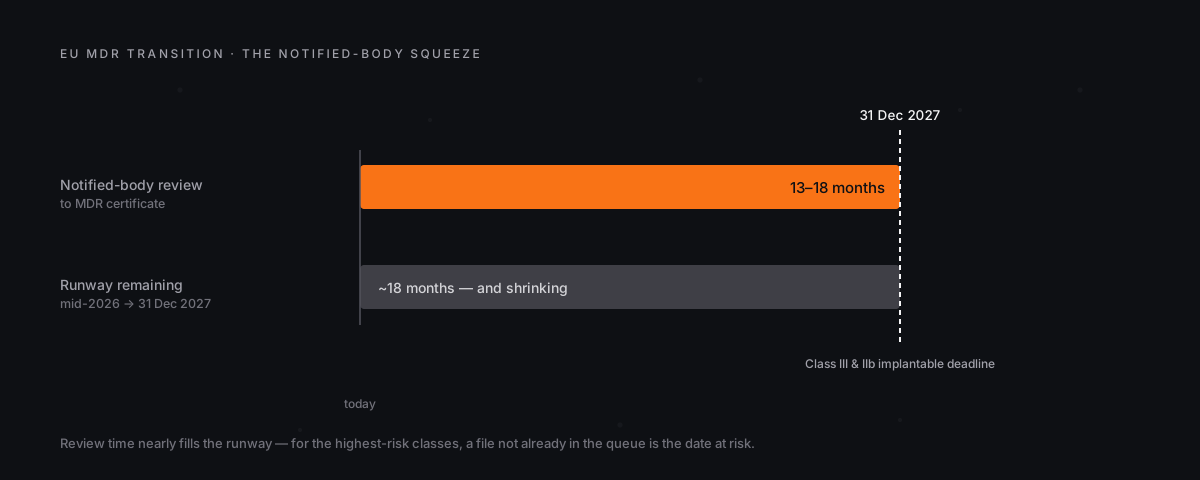
Under Regulation (EU) 2023/607, legacy MDD devices must complete their MDR transition by 31 December 2027 for Class III and Class IIb implantable devices, and 31 December 2028 for other Class IIb, Class IIa and Class I devices — but only if you met the notified-body milestones in 2024. With notified-body review running 13 to 18 months and capacity tight, a Class III or implantable manufacturer without an active, progressing application by mid-2026 is at real risk of missing the 2027 date.
What are the deadlines, and who still qualifies?
The MDR transition was extended by Regulation (EU) 2023/607, and the deadlines now run by device risk class rather than as one cliff. Two dates matter for legacy devices still being placed on the market under the Article 120 transition.
31 December 2027 ends the transition for Class III and Class IIb implantable devices, with narrow exceptions for items like sutures, staples, and dental fillings. 31 December 2028 ends it for other Class IIb, Class IIa, Class Is/Im, and up-classified Class I devices. The same regulation removed the old sell-off period, so compliant legacy stock can stay on the market without a fixed end date beyond its own shelf life.
The extension is conditional, not automatic. To keep it, a manufacturer had to lodge a formal conformity-assessment application with a notified body by 26 May 2024 and have a signed written agreement in place by 26 September 2024. Miss those gates and the extended transition does not apply — the device’s existing certificate governs, and there is no fallback to the 2027/2028 dates.
Why is notified-body capacity the real constraint?
Because the bottleneck is rarely the legal text — it is the queue. Notified bodies are absorbing a surge of applications as the 2027 and 2028 dates converge, and a successful MDR certification review currently runs 13 to 18 months, longer for complex devices.
Do the arithmetic against the first deadline. A Class III or Class IIb implantable device needs its MDR certificate issued by 31 December 2027. If review alone takes 13 to 18 months, an application that is not already active and progressing by mid-2026 has little margin for the inevitable questions, evidence gaps, and resubmissions. The deadline that matters operationally is not 31 December 2027 — it is the date your file has to enter the queue to clear it in time, and for the highest-risk classes that date is now.
What gets an MDR application refused or delayed?
The failure modes are documented, and most are avoidable. A notified-body survey published by the European Commission found the leading reasons applications were refused: around 55% were outside the scope of the notified body’s designation, about 16% were incomplete, and roughly 14% involved incorrect product classification.
Read that list closely, because none of the top three is a clinical-evidence problem. They are matching and completeness failures: applying to a body not designated for your device type, submitting a file that is missing required content, or getting the classification wrong so the whole route is mis-set. The clinical and post-market-surveillance burden under MDR is heavier than under the old Directive — more clinical evaluation, ongoing post-market clinical follow-up, periodic safety update reports — but the early rejections are administrative, the same pattern that runs through every regulated-hardware regime, including how the EU Cyber Resilience Act assigns a conformity assessment route.
How long does the work actually take?
Longer than the calendar suggests, which is the same trap that makes a 510(k) take far longer than its headline goal. The MDR technical file is not a reformatted MDD file — it is a reassembly. Equivalence claims that carried an MDD submission are far harder to sustain under MDR, so clinical evidence often has to be generated or restructured. Post-market surveillance, PMCF plans, and the PSUR cycle have to be built and running. UDI assignment and EUDAMED registration have to be in place. A Person Responsible for Regulatory Compliance has to be designated.
Treat the class deadline as the date your certificate must be issued by, then work backwards: subtract the 13-to-18-month review, subtract the time to remediate the questions a review always raises, and subtract the months to reassemble the technical file. What remains is how long you actually have to start — and for Class III and implantable devices, that runway is largely gone.
What should you do now?
Four moves, in priority order, for any manufacturer with legacy devices still in transition.
- Confirm your devices still hold the extension — verify the 2024 notified-body application and signed-agreement milestones were met for each legacy device. Anything that missed them is not on the 2027/2028 timeline at all.
- Map every device to its class deadline and its certificate date — separate the Class III and IIb-implantable devices (31 December 2027) from the rest (31 December 2028), and treat the review duration as fixed lead time. The EU MDR transition deadline tracker keeps the dates and conditions in one place; what changed from MDD to MDR lays out the evidence step-up driving the work.
- Pressure-test the application against the top refusal reasons — confirm the notified body is designated for your device type, the classification is correct, and the file is complete before submission. The three biggest refusal causes are all checkable in advance.
- Start the technical-file reassembly from the certificate date backwards — clinical evidence, PMS and PMCF, UDI and EUDAMED, and the PRRC role. The work is evidence reassembly across systems, not a document refresh.
For most scaling medtech teams the constraint is the evidence reassembly that runs upstream of the notified-body queue. ForgeComply maps a device’s existing technical file to MDR’s required structure, surfaces the gaps between what the regulation demands and what the legacy file holds, and assembles the evidence from a live product context graph rather than a manual rebuild. When the deadline is a notified-body certificate date and the lead time is over a year, the work that decides the outcome is getting a complete, correctly classified file into the queue early.
Key takeaways
- Two class deadlines — 31 December 2027 for Class III and Class IIb implantable devices; 31 December 2028 for other Class IIb, Class IIa and Class I devices, under Regulation (EU) 2023/607.
- The extension is conditional — it applies only to devices that met the 26 May 2024 notified-body application and 26 September 2024 signed-agreement milestones.
- Capacity is the real constraint — notified-body review runs 13 to 18 months, so a Class III or implantable file not active by mid-2026 is at material risk of missing 2027.
- Early rejections are administrative — the top refusal reasons are scope mismatch, incomplete files, and incorrect classification, not weak clinical data.
- The deadline is a certificate date — work backwards from it through review time, remediation, and file reassembly to find when you actually have to start.